
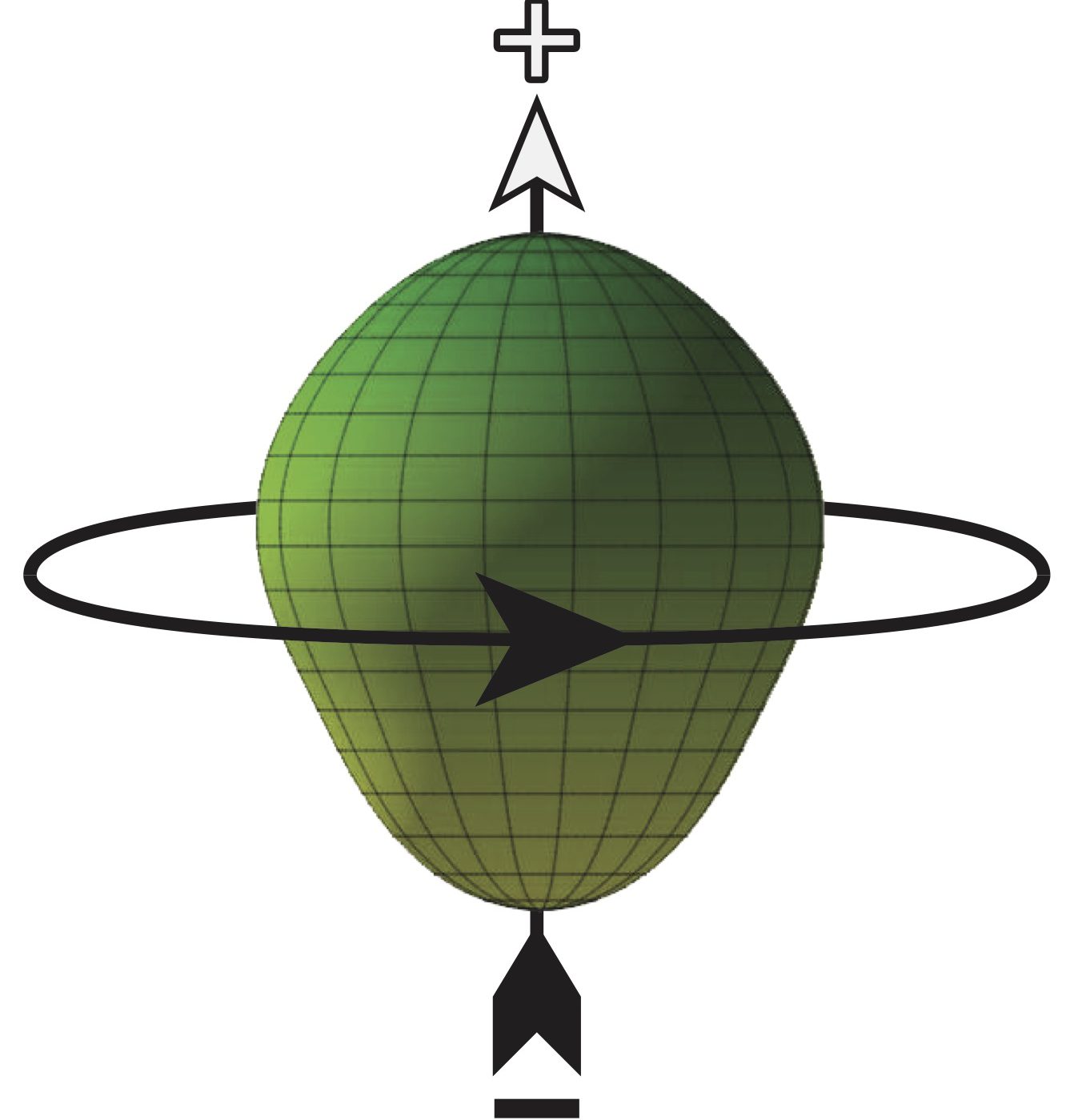

Published on this day 75 years ago is the paper by Edward M. Purcell and Norman F. Ramsey that launched search for the permanent electric dipole moment (EDM) neutrons, electrons, atomic nuclei, and other elementary particles such as muons. Ramsey recounts the story of how this paper and the first search for the EDM of the neutron came about in this Oral History Interview by the APS on November 27, 2006:
One day I was planning to discuss nuclear magnetic moments and was preparing to give the then standard proof that one did not have to waste time looking for electric dipole moments since they were known to be impossible by the then universally believed assumption of parity, P, (left hand-right hand) symmetry. I knew the proof well, but then I had the worrisome thought that Ed might ask me for the experimental evidence for the “universal belief” in the parity symmetry assumption for nuclear forces. I looked up all the books I knew and could find no proof. Finally, on the military principle that, if about to be attacked, counter attack, I went to Ed two days before my class and said that I could find no proof in the case of nuclear forces. He said there must be lots of proofs, but he could not find any proof either, so we published a paper saying there was no experimental evidence for the assumption of parity symmetry for nuclear forces and set up an experiment with a graduate student, Jim Smith to find or set a limit to the electric dipole moment of the neutron as a test of parity.
I soon learned the following. First, it was wonderful to have him in my course. After almost every lecture, we’d have interesting discussions. We had a fine time together and we both got new ideas from it. However I also soon learned that if I tried to give a derivation that I did not fully understand, there was a high probability that Ed might ask me an astute question that would show I did not.
Well, sometimes they do. I think a very important and very interesting subject is: Where do totally new ideas come from? I will give an example from my own experience. In 1949, my second year teaching at Harvard, I was giving a graduate seminar on molecular beams. We had a good magnetic resonance molecular beam apparatus. I was giving a graduate seminar on the subject.And Ed Purcell — who was on the faculty and one of my very best friends — was sitting in on my course.
We chose the neutron because it would not be accelerated from our apparatus by the applied electric field. Although we did not find an electric dipole moment, seven years later a failure of parity in the weak nuclear force was discovered. With this elimination of the parity argument theorists then said there still could be no electric dipole moment of the neutron because of time reversal, T, symmetry. I then wrote another paper pointing out that there was no experimental evidence for T symmetry in nuclear forces so we continued our search. Several years later other experimentalists found a failure of T symmetry in the decay of the KL0 particle.
With the failures of both the P and T, arguments against electric dipole moment searches, a number of different electric dipole moment searches are now in progress. I must admit, our paper originally pointing out that we were going to do an electric dipole moment experiment was pretty thoroughly ignored because everybody knew the answer. It was still sort of fun giving colloquia at the time while we were doing that experiment because you could always count on bright young theorists saying that “that’s a stupid experiment because one can’t have an electric dipole moment because of parity” To which we replied, that is what we are testing. NRF November 27, 2006
The experiment was the PhD thesis research of James H. Smith (1925-2008) and was started in 1950 and completed by 1951. It was originally intended to be a search for parity violation, but no violation was observed.

The null result was so expected that they did not even bother publishing it until 1957 when the question of parity violation in the weak interactions gained significant interest.
This experiment was successfully completed several years ago. However, the negative results of the experiment were in accordance with the then widely accepted views on parity so the detailed description4 of the experiment was not published. Phys. Rev. 108, 120 1957
Reference 4 in the quote above is James H. Smith’s 1951 Harvard PhD dissertation. A scan of Ramsey’s copy of this dissertation is given below:
It was realized soon afterwards by Lee & Yang that EDMs violate time reversal in addition to parity violation. Ramsey pointed out that neutron EDMs are a very sensitive probe of time-reversal violation and this motivated his lifelong quest to search for neutron EDM. This has since become a world-wide search of EDMs in a variety of systems, but none has been found yet!
You must be logged in to post a comment.