
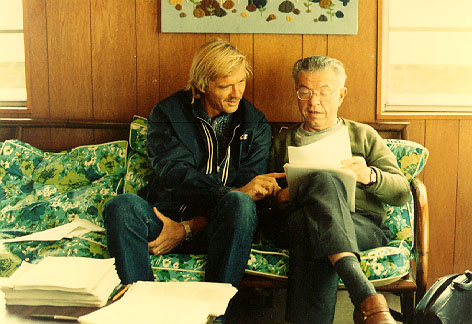

Today is Fred Hoyle‘s 110th Birthday! The photo above includes the following original caption:
Donald Clayton and Fred Hoyle at rented cottage on the beach in Freeport TX in March 1975 for a weekend. They revise drafts of Hoyle’s letter to The Times (London, Apr 8, 1975) concerning Jocelyn Bell and the omitted share of the Nobel Prize. Handwritten drafts are still in Clayton’s possession.
The original article and Hoyle’s subsequent letter to the The Times (London) pointing out the snubbing of Jocelyn Bell Burnell for the 1974 Nobel Prize in Physics are given below:


It is claimed that his vitriolic stance towards the Nobel Prize Selection Committee cost him a share of the 1983 Nobel Prize in Physics with Willy Fowler for the development of stellar nucleosynthesis. He was one of the four authors, along with the Burbidges and Fowler, of the famous B2FH paper that essentially launched the field of nuclear astrophysics.
Hoyle also deduced that Carbon-12 must have an excited nuclear state with an energy that nearly equals the mass of Be-8 combined with He-4 or equivalently three alpha particles. This so-called Hoyle State was subsequently observed at Caltech in 1957 by Fowler and his team and is still the subject of considerable study in contemporary nuclear astrophysics. His prediction is considered one of the first successful applications of the anthropic principle. This paper along with a 1946 paper are claimed to be under-cited by both Donald D. Clayton and Geoffrey Burbidge and is another reason why Hoyle may have missed the Nobel Prize in 1983.
Hoyle also coined the term “Big Bang” in a public radio program on the BBC on March 28, 1949 and he may or may not have meant this phrase to have been derogatory. He certainly did not believe that Big Bang cosmology was correct and espoused the Steady State Theory of the Universe until his death.
He also wrote over a dozen works of science fiction including my personal favorite The Black Cloud.
You must be logged in to post a comment.